Dubai's energy sector looks very different today because of one big change: Dubai Electricity and Water Authority (DEWA) adopted the independent producer model. This shift has cut the cost of solar power and water desalination to some of the lowest levels seen anywhere. It has also changed how Dubai brings in investment, spreads risk, and speeds up new infrastructure. The model fits with the Dubai Economic Agenda D33 and the UAE's Vision 2031, both focused on sustainable growth and global competition, as shown in recent WAM state news agency coverage.
DEWA no longer relies on old-style government-funded contracts. Instead, it teams up with private developers from around the world. These partners finance, build, and run major power and water plants. This has brought more competition, new ideas, and tighter financial controls. Dubai has become a draw for international money and know-how. Emirates News Agency (WAM) reports that this approach has helped Dubai become a regional center for clean energy investment and technology transfer.
How the independent producer model works
Before, DEWA paid for and built new plants itself, taking on all the risk. The independent producer model changes that. Now, DEWA sets up project companies with private developers. These developers handle the financing, design, construction, and day-to-day running of the plants. DEWA agrees to buy the output at a fixed price for many years. Payments depend on how well the plants perform and how reliable they are.
This setup has pulled in global developers and investors. Competition is fierce, and new technology gets adopted quickly. Saeed Mohammed Al Tayer, DEWA's Managing Director and CEO, has said in statements reported by The National that the model has sped up infrastructure work, made spending more efficient, and brought in top-level investment and expertise.
DEWA can now grow its capacity without paying all the upfront costs. This frees up money for other needs, like smart grids and network upgrades. Each party takes on the risks they know best, from building to long-term operation. In September 2026, Reuters reported that DEWA plans to award a consultancy contract for new water treatment plants in Q4 2026. This shows the project pipeline is still growing and that DEWA is pushing ahead with new water infrastructure.
Record-breaking solar and water prices
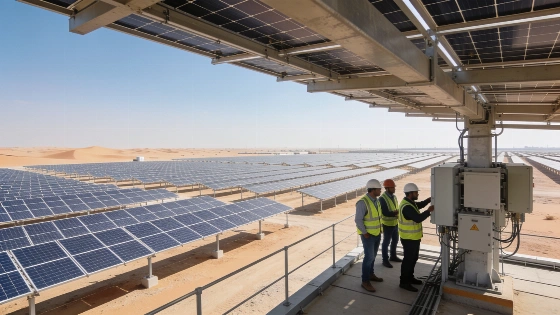
The results are clear at the Mohammed Bin Rashid Al Maktoum Solar Park. Competitive bidding under the independent producer model has pushed solar electricity prices down from 5.6 US cents per kilowatt-hour in the second phase to just 1.6215 cents in the sixth phase. These are some of the lowest solar prices ever seen worldwide. This was made possible by global competition, long-term financing, and constant innovation. pv magazine Global reports that DEWA's assets are closely linked to large-scale solar projects, with recent bids for an 800 MW third-phase project and a 900 MW sixth-phase EOI process.
For water, the Hassyan seawater reverse osmosis project-also using the independent producer model-will add 180 million imperial gallons per day at a tariff of $0.3653 per cubic metre. It uses advanced low-energy technology. The project's investment of about AED 3.4 billion will raise Dubai's total desalinated water capacity to 735 million imperial gallons daily. Of this, 308 MIGD will be powered by renewable energy, as confirmed by Reuters. This expansion is central to DEWA's plan to secure water for Dubai's growing population and economy.
Since 2014, the model has brought in AED 47.4 billion in investment for Dubai's energy and water sector. This is not just a paper saving. It is real private money that DEWA no longer needs to raise itself. That lets the authority focus on network and digital upgrades. The Central Bank of the UAE (CBUAE) has said that these public-private partnerships help drive foreign direct investment and support the UAE's wider economic diversification goals.
Broader economic and environmental impact
DEWA's independent producer projects are anchored by the Mohammed Bin Rashid Al Maktoum Solar Park. The park now delivers 3,860 megawatts and is set to go beyond 8,000 megawatts by 2030. This is well above the original 5,000-megawatt target. Clean energy now makes up 21.5% of Dubai's total power generation. Projections show this could rise above 36% by 2030, cutting more than 8.5 million tonnes of carbon emissions each year.
The sixth phase of the solar park, now being built, will add 1,800 megawatts. The seventh phase will bring in 2,000 megawatts of photovoltaic panels and 1,400 megawatts of battery storage. This will make it one of the world's biggest solar-plus-storage projects. Other major projects include the fourth, fifth, and sixth phases of the solar park, the Hassyan power complex, and the Hassyan desalination plant.
The model has also opened the door to new technology like concentrated solar power, solar tracking, thermal and battery storage, and next-generation desalination. It has helped transfer knowledge, build local skills, and grow engineering, legal, and financial services linked to these projects. As shown in recent analysis, Dubai's ability to attract foreign investment and expertise is now a key part of its infrastructure strategy. DEWA's work was recognized with the 2026 Technology & AI Award for EMEA from Forrester, showing its leadership in digital utility transformation.
What this means for Dubai's future
For people and businesses in Dubai, the independent producer model means more reliable, efficient, and sustainable energy and water-at prices that compete with the best in the world. For the city's economy, it means steady foreign investment, a stronger place in global clean energy markets, and a base for long-term growth in the green economy.
DEWA's model is more than just a way to finance projects. It is a new way for public and private sectors to share risk, reward, and responsibility. By building on clear government vision, strong regulation, and open competition, Dubai has turned its infrastructure into a global investment magnet. This model is now at the heart of the city's clean energy and net-zero goals for 2050, and is a benchmark for how cities can use private capital to deliver public value at scale.