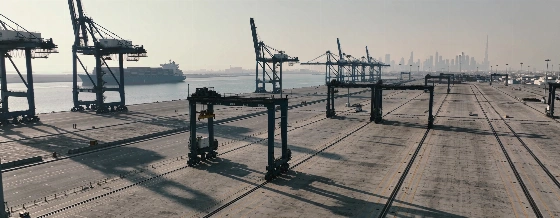
Jebel Ali Port, the engine of Dubai's non-oil economy, has seen cargo volumes plummet by over 90 percent as war disrupts shipping through the Strait of Hormuz. The crisis exposes the city's reliance on a single maritime gateway and triggers urgent investment in alternative ports.
Jebel Ali Port, the linchpin of Dubai's global trade ambitions, has been brought to a near standstill. In the wake of war in the region, shipping activity at the port has collapsed by more than 90 percent, according to senior officials at DP World. The sudden paralysis of this logistics giant has sent shockwaves through Dubai's economy, revealing just how much the city's fortunes are tied to a single maritime artery.
For decades, Jebel Ali Port has been the foundation of Dubai's transformation from a regional trading post into a world-class logistics and commercial hub. Its integration with the Jebel Ali Free Zone, established in 1985, enabled companies to import, manufacture, and re-export goods with minimal friction. Today, more than 11,000 companies from 130 countries operate in the free zone, including over 100 of the world's largest corporations. The zone alone accounts for more than 21 percent of Dubai's GDP, and Jebel Ali Port is estimated to generate around 30 percent of DP World's total revenue.
Shipping gridlock exposes economic risk
The current crisis was triggered by the outbreak of war, which choked vessel movement through the Strait of Hormuz. Data from Clarksons, a leading shipping brokerage, shows that average daily ship crossings through the strait plunged from 135 before the conflict to just 17 by late August 2026. On some days, only four commercial vessels managed to pass through, compared to a pre-war average of 125. Even after a temporary ceasefire and partial reopening in June, traffic has barely recovered.
"Dubai as we know it would not exist without Jebel Ali," said Jim Krane, a Middle East energy researcher at Rice University. The port's unique combination of maritime, air, and land logistics has made Dubai a cost-effective gateway for global trade. But the war has exposed the fragility of this model: when the port stalls, so does much of the city's economic engine.
Scramble for alternatives beyond the strait
With Jebel Ali's operations crippled, DP World and other UAE port operators are racing to build capacity outside the Strait of Hormuz. In July, DP World announced a 50-year concession to develop two new terminals in Al Rughailat and Dibba, Fujairah, aiming to deliver half the cargo-handling power of Jebel Ali within 24 to 30 months. Gulftainer, another major UAE port operator, has committed $2 billion to expand Khorfakkan and its logistics network. Meanwhile, French shipping giant CMA CGM and Oman's Asyad Group are investing $400 million in a new multipurpose terminal at Sohar Port, positioning it as a strategic trade corridor that bypasses the strait entirely.
Despite these moves, industry leaders are blunt about the limits of substitution. "You cannot replicate the same system in Fujairah," a senior UAE official told the Financial Times, citing Jebel Ali's unmatched infrastructure, services, and transport links. Steve Williams, CEO of Nippon Express UK, noted that Dubai's unique blend of sea and air logistics-where goods arrive by ship and are flown onward-cannot be easily recreated elsewhere.
Dubai's economic model under pressure
The crisis has laid bare the risks of overreliance on a single port. As Adil Malik, associate professor of development economics at Oxford University, explained, Dubai's non-oil growth has been built on a model of free trade, integrated ports, and open capital flows. While this has insulated the city from the oil dependency of its neighbours, it has also concentrated risk in one critical node.
DP World's financials, released in March, showed a 22 percent revenue increase to $24.4 billion in 2025, but the figures mask the acute pain at Jebel Ali. Recovery in shipping volumes has been minimal since the initial shock, and the city's broader logistics sector remains in limbo.
Dubai's response-massive investment in alternative ports and logistics corridors-signals both resilience and vulnerability. The city's ability to adapt will depend on how quickly these new routes can be made operational and whether they can match the scale and efficiency of Jebel Ali. For now, the war has forced Dubai to confront the hard truth that its economic miracle is only as strong as its weakest link. The lesson is clear: diversification is no longer a strategic option, but an urgent necessity for the city's future stability.