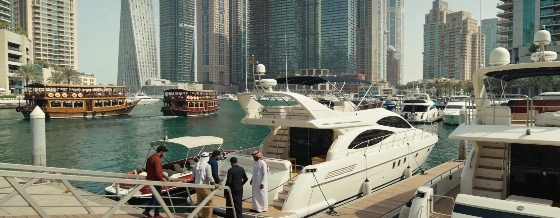
Dubai's maritime sector now counts 8,415 registered vessels and more than 14,000 marine companies, supported by advanced infrastructure and a diverse international user base. The city's marine ecosystem is driving economic growth and reinforcing Dubai's global status as a leading maritime hub.
Dubai's marine industry has reached a new milestone, with 8,415 vessels officially registered and over 14,000 companies now operating in the sector. This surge is not just a matter of numbers-it signals a strategic transformation of Dubai's economic landscape, as the city positions itself as a global maritime powerhouse.
At the heart of this expansion is a robust infrastructure: 20 marinas and 4,214 berths are now in place, enabling the sector to absorb rising demand for marine activities and services. The diversity of users is striking, with individuals and businesses from 116 nationalities participating in Dubai's marine economy, according to the latest data from the Dubai Maritime Authority.
Marine Activity Diversifies Across Leisure and Commerce
The registered fleet is anything but homogenous. Powered leisure boats dominate the scene, accounting for 3,269 vessels, followed by 2,377 water sports craft and 1,064 tourism-focused boats. Commercial marine vehicles, group transport vessels, and a range of other categories round out the ecosystem, reflecting the sector's adaptability to both recreational and business needs.
Floating restaurants have become a signature feature of Dubai's waterways. The Dubai Maritime Authority has licensed 87 such venues-58 wooden and 29 non-wooden-collectively able to host up to 9,600 guests. These floating establishments cluster around high-profile destinations like Dubai Marina, Dubai Creek, Dubai Harbour, and Al Jaddaf Waterfront, blending hospitality with the city's aquatic identity.
Regulation and Investment Drive Sector Confidence
Dr Saeed bin Ahmed bin Khalifa Al Maktoum, CEO of Dubai Maritime Authority, emphasises that the sector's development is a deliberate pillar of Dubai's economic strategy. The authority's ongoing efforts to refine regulatory frameworks and safety standards are designed to attract global operators and investors, while ensuring operational efficiency and user protection.
Collaboration between government and private stakeholders is central to this approach. The authority's remit covers the entire 72-kilometre Dubai coastline, extending to the city's exclusive economic waters. By continuously upgrading both regulatory and operational services, Dubai aims to maintain investor confidence and secure its place as a world-class maritime destination.
Dubai's marine sector is not simply growing-it is evolving into a sophisticated, multi-layered ecosystem that supports the city's ambitions for a sustainable blue economy. The numbers are impressive, but the real story is the city's ability to convert infrastructure, regulation, and international participation into tangible economic momentum. As other global cities struggle to modernise their marine sectors, Dubai's integrated approach is setting a new standard for what a maritime hub can achieve.