
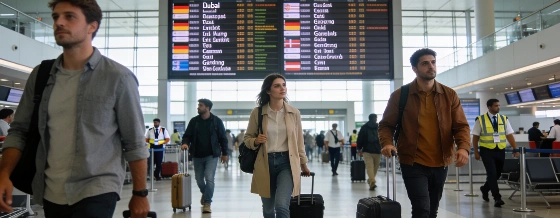
Dubai International Airport will handle the majority of 1335 scheduled direct flights between the UAE and Germany in Q3 2026, with over 324000 seats offered. Expanded routes and new airline partnerships are set to transform travel and tourism flows between the two countries.
Dubai is set to dominate the UAE-Germany air corridor in 2026, with Dubai International Airport alone accounting for 819 of the 1335 direct flights scheduled between the two countries in the third quarter. This translates to a staggering 324,200 seats-71% of all UAE-Germany capacity-cementing Dubai's status as the region's primary aviation gateway to Europe.
What's driving this surge? The answer is a strategic expansion of direct routes, aggressive seat scheduling, and a new wave of airline partnerships that are fundamentally redrawing the travel map between Dubai and Germany. Travellers will see more options, more destinations, and a level of connectivity that rivals any European hub.
Direct routes multiply as airlines compete for German travellers
Dubai's direct links to Frankfurt, Munich, Düsseldorf, and Hamburg are not just holding steady-they're expanding. The Dubai-Frankfurt route alone will offer nearly 105,800 seats in July, August, and September 2026, making it the single largest air bridge between the UAE and Germany. Munich, Düsseldorf, and Hamburg follow closely, each with tens of thousands of seats scheduled for the summer peak.
But the competition is not limited to Dubai. Abu Dhabi's Zayed International Airport is stepping up with 427 flights and 114,300 seats to Frankfurt, Munich, and Düsseldorf, leveraging Etihad Airways' network and new code-share deals. Sharjah, meanwhile, is carving out its own niche with Air Arabia's direct service to Munich, offering 89 flights and 16,500 seats in the same period. The message is clear: German travellers now have more entry points and more flexibility than ever before.
German airlines ramp up presence as new partnerships take flight
The influx is not one-sided. German carriers are aggressively expanding their UAE operations. Lufthansa maintains daily direct flights between Dubai and Frankfurt, and also connects Abu Dhabi to Frankfurt. The real shake-up comes from Condor, which is launching daily direct flights from Frankfurt and Berlin to Abu Dhabi starting May and June 2026, using Airbus A330 and A320 aircraft. These flights are part of a code-share with Etihad Airways, opening up onward connections across the Middle East, Asia, Africa, and Australia.
Condor is also adding daily Berlin-Dubai flights and maintaining its Frankfurt-Dubai service, injecting fresh seat capacity and intensifying competition. Meanwhile, Eurowings, a Lufthansa Group subsidiary, is set to resume direct flights to Dubai from Berlin, Stuttgart, and Cologne from 25 October 2026, after a temporary suspension. This influx of German airline capacity is not just about numbers-it's about strategic positioning in a market that is now fiercely contested.
Frankfurt and Munich emerge as key German gateways
Frankfurt stands out as the undisputed German hub for UAE-bound traffic, with 451 flights and 161,200 seats scheduled in Q3 2026. Munich is close behind, with 430 flights and 141,900 seats. Düsseldorf and Hamburg round out the list, reflecting a deliberate strategy by both UAE and German airlines to diversify entry points and capture a broader segment of the German market. The days of relying on a single city for international connections are over.
Tourism and economic impact for Dubai
This aviation boom is not just about moving people-it's about moving markets. The expanded direct connectivity is expected to drive a new wave of German tourism to Dubai, Abu Dhabi, and Sharjah, with each emirate offering distinct experiences and products. For Dubai, the stakes are especially high: as the main beneficiary of increased seat capacity and route diversity, the city is positioned to capture a larger share of high-value German visitors, business travellers, and transit passengers heading to Asia and beyond.
For airlines, the battle for market share is intensifying. The entry of new German carriers, the return of Eurowings, and the aggressive expansion by UAE airlines mean travellers will benefit from lower fares, more choices, and improved connectivity. But it also signals a new era of competition where only the most agile and customer-focused operators will thrive.
Dubai's aviation sector is not just keeping pace with global trends-it is setting them. The city's ability to attract new routes, forge international partnerships, and deliver unrivalled connectivity is no accident. It is the result of deliberate strategy, infrastructure investment, and a relentless focus on making Dubai the region's indispensable travel hub. As 2026 approaches, the numbers speak for themselves: Dubai is not just a stopover-it is the destination of choice for German travellers, and the rest of the region is scrambling to keep up.