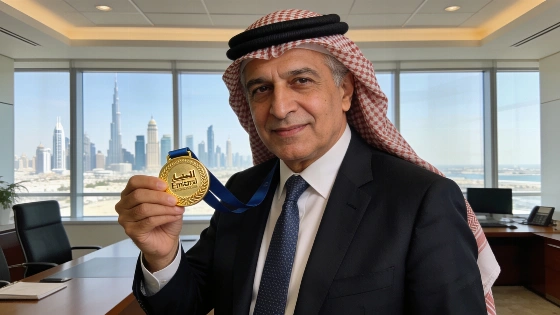
Emirates NBD just took home the UAE's highest federal award for corporate responsibility again. The bank secured the "Community Impact Medal - Gold Category" for the second straight year. Majra - the National CSR Fund - gave out the honour. This puts Emirates NBD at the front of the pack for real, measurable progress in social and environmental work. According to Al Bayan business coverage, the medal is the UAE's top federal prize for corporate social responsibility and sustainable development. Emirates NBD stood out among 114 organisations in 2026. That's no small feat.
Majra's process is tough. The three-stage review checks governance, sustainability strategy, transparency, and whether a company can deliver long-term value. Emirates NBD made its mark by weaving sustainability into its daily work, company culture, and products. The bank's approach matches the UAE government's push for ESG standards and open reporting in finance. The rules are getting stricter. Emirates NBD is keeping pace.
But it's not just about size. The bank's results are clear. Its Exchanger volunteer programme has logged over 160,000 hours of community service. More than 1.1 million people have benefited. The work covers inclusive banking, financial inclusion, employee wellbeing, and direct community projects. Many banks are still behind in these areas. Emirates NBD's efforts line up with UAE Vision 2021 and the country's wider social goals.
On the environment, Emirates NBD has moved past talk. The bank runs climate awareness drives, manages resources, and cuts emissions. It has a strong ESG governance system. These steps tie directly to the UAE's Net Zero 2050 Strategy and the United Nations Sustainable Development Goals. The bank is helping the country shift to a low-carbon economy. Gulf Daily News notes that Emirates NBD's annual sustainability report follows GRI standards and links closely to both UAE Vision 2021 and the UN SDGs.
Emirates NBD's leadership goes beyond its own walls. It was the first bank in the world to publish a sustainability report that matches both IFRS S1 and IFRS S2 standards. The report includes independently checked data on financed emissions. Its subsidiary, Emirates Islamic, launched the world's first sustainability-linked sukuk worth $500 million. The sukuk meets all ICMA guidelines. This move backs the UAE's goal to become a global centre for sustainable finance. Recent WAM state news agency reports show the country's sukuk market is growing fast.
The bank's partnerships and thousands of volunteer hours each year support education, the environment, and social development. Emirates NBD is not just ticking boxes. It is building sustainability into every part of its business, from products to staff engagement. The bank's public support for the UN Principles for Responsible Investment (UN PRI) and its open ESG reporting in annual reports show it takes responsible banking seriously.
Vijay Bains, Group Chief Sustainability Officer and Head of ESG at Emirates NBD, said, "Emirates NBD recognises the pivotal role the financial sector plays in enabling the transition to net zero. As a responsible institution and trusted partner, the bank is committed to mobilising capital, supporting sector-wide emission reductions, and integrating climate risk into investment and lending decisions."
This gold medal also fits into the UAE's bigger plan to build an "impact economy," as set out in the Emirates Companies for Good 2031 strategy. The award signals a shift. Private sector work on sustainable development is now a real benchmark, not just a formality. The Central Bank of the UAE (CBUAE) and Dubai Financial Services Authority (DFSA) have both issued new rules. Banks are being pushed to adopt strong ESG frameworks and open sustainability reporting. The bar keeps rising.
Emirates NBD is a heavyweight. Its assets hit AED 1.3 trillion as of June 2026. The bank operates in 13 countries. It serves over 25 million active customers. More than 97% of its transactions happen outside branches. That's digital leadership. Its digital bank, Liv, is the fastest-growing in the region, with nearly half a million customers. Emirates NBD also led as receiving bank for the UAE Ministry of Finance's second retail T-Sukuk issue, working with Emirates Islamic, Abu Dhabi Islamic Bank, Ajman Bank, Mashreq, ADCB, and FAB. This shows its central role in the UAE's financial system and its push for new, Sharia-compliant products.
For Dubai's financial sector, this is more than a trophy. As reported earlier, the city's global financial reputation now depends on real, measurable impact-not just profit. Emirates NBD's repeat gold win sets the standard for responsible banking in the UAE's next economic phase. The message is clear. In Dubai, sustainability and social value are now at the heart of financial leadership. They are not optional.