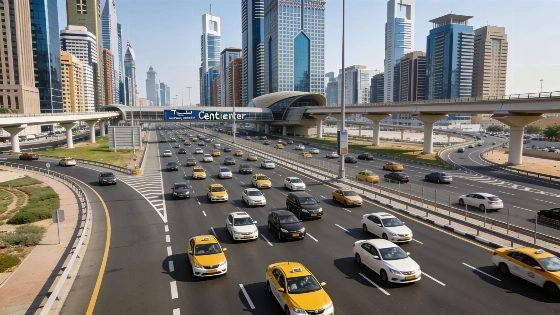
Rush hour at Dubai's Trade Centre intersection looks different now. The notorious roundabout, once a magnet for gridlock, has been replaced by a surface junction that the Roads and Transport Authority (RTA) claims has slashed average delays from 12 minutes to 90 seconds. These numbers come straight from RTA data, but so far, no independent technical audit or third-party transport study has confirmed them. Regional outlets have flagged the lack of outside verification.
The RTA didn't just tweak the old layout. The new junction is built to handle a much heavier load, with the agency stating it can now take on twice as many vehicles as before. Drivers heading from Sheikh Zayed Road to 2nd of December Street, and those moving south on Sheikh Zayed Road from Al Mustaqbal Street, now get a clear run. The redesign also opens up direct movement from 2nd of December Street to Al Majlis Street, which links to Al Mustaqbal Street, and from Sheikh Rashid Road toward Deira. These routes, confirmed by the RTA, are meant to ease pressure for commuters and commercial vehicles. The project lines up with Dubai's Economic Agenda D33, which puts a premium on smoother logistics and faster city movement.
Turning the Trade Centre roundabout into a surface junction was a direct answer to years of chronic congestion. The old bottleneck is gone. In its place, the RTA has built a web of connections that let both daily drivers and freight haulers move without the usual stop-and-go. Journey times have dropped, and drivers who once dreaded the area now see a real difference. The Emirates News Agency (WAM) has pointed to these infrastructure upgrades as a core part of the UAE Vision 2031, where transport efficiency is seen as a backbone for Dubai's business ambitions.
Dubai's push for better mobility hasn't slowed. As reported earlier, city officials have rolled out new rules and infrastructure projects across several districts to keep up with rapid growth and heavier demand on public services. The Dubai Media Office keeps spotlighting these projects as key to the emirate's competitiveness and quality of life, echoing regulatory reforms from the Dubai Financial Services Authority (DFSA).
The Trade Centre junction overhaul signals the RTA's intent to back high-impact projects that deliver measurable results. A drop from 12 minutes to 90 seconds isn't just a talking point-it's a shift that thousands of drivers and businesses will notice every day. Still, the RTA has not released details on the project's cost, construction timeline, contractor, lane count, or post-opening traffic volumes. That gap remains, as confirmed by the RTA's public statements and recent WAM state news agency reports.
The RTA's willingness to rip out legacy infrastructure and put in smarter, higher-capacity solutions shows a pragmatic, data-driven approach to city planning. For drivers, the payoff is less time stuck in traffic and more time at their destination. Bloomberg and The National have both highlighted how these infrastructure moves help Dubai attract foreign investment and expand its global reach.