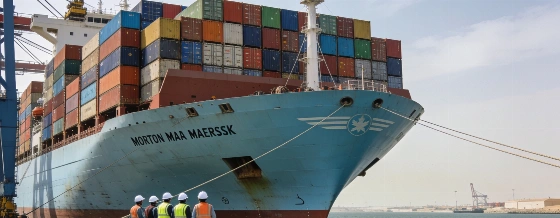
The Morton Maersk, nearly 400 metres long and able to carry over 19,000 TEU, recently docked at Jeddah Islamic Port's South Container Terminal. This is a significant development for Saudi Arabia's efforts to become a key player in global shipping, giving importers and exporters direct access to major trade routes connecting Asia, the Mediterranean, and Europe. The ship's size and capacity, confirmed by industry sources, show the scale of infrastructure now in place at Jeddah and the port's ability to handle some of the world's largest container vessels. This move supports Saudi Arabia's Vision 2030 logistics goals.
The Morton Maersk is now part of the AE15 service, operated by Maersk and Hapag-Lloyd under the Gemini Cooperation alliance. This service change puts Jeddah on one of the busiest shipping lanes worldwide. According to Maersk's latest Europe Market Update, both AE15 and AE19 services now use the Suez Canal instead of sailing around the Cape of Good Hope, speeding up cargo movement between Asia and Europe. The AE15 route connects Jeddah directly to major Asian ports like Qingdao, Kwangyang, Ningbo, and Tanjung Pelepas, as well as Mediterranean hubs such as Port Said and Damietta. This confirms Jeddah's role in the Asia-Mediterranean network of the Gemini Cooperation.
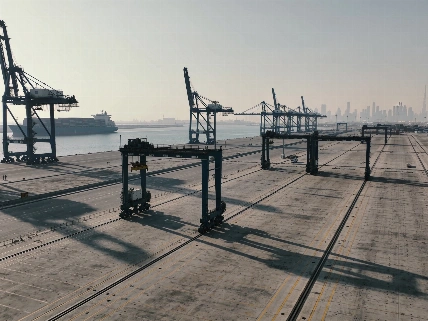
DP World continues to invest in Jeddah's South Container Terminal, adding new equipment, automation, and emissions-reduction measures to handle growing cargo volumes. In August 2026, CMA CGM and Red Sea Gateway Terminal signed agreements to develop Terminal 4 at Jeddah Islamic Port, with investments of about $434-435 million and a planned capacity of up to 2.6 million TEU per year. The new terminal will include deepwater berths and 10 ship-to-shore cranes. These upgrades are part of broader regional logistics plans reported by the Emirates News Agency (WAM) and are expected to further strengthen Saudi Arabia's position as a trade hub.
The AE15 service now passes through the Suez Canal, following a change announced by Maersk and Hapag-Lloyd for July 2026. This adjustment is meant to shorten transit times for cargo between Asia and Europe, and Jeddah's inclusion increases the network's flexibility. The ongoing development of the South Container Terminal is timed with these service expansions, making sure the port can meet the demands of modern shipping. Gemini Cooperation has also added four more services to the AE15 and AE19 routes, all now using the Suez Canal, which points to a wider shift in network planning, as reported by Bloomberg and regional logistics analysts.
For Saudi businesses, these direct links to Asian and European markets mean faster transit, lower costs, and fewer logistical obstacles. Jeddah is now positioned as a strong alternative to traditional regional transshipment hubs, raising competition among Middle Eastern ports. This mirrors the kind of logistics expansion seen in Dubai, where recent investments have turned the city into a major cargo center. The Central Bank of the UAE (CBUAE) has highlighted the importance of resilient supply chains and direct maritime links for non-oil trade growth, a policy now echoed in Saudi Arabia's port modernization efforts.
DP World's push to modernize Jeddah's port infrastructure is about more than just capacity. By bringing in the world's largest ships and introducing advanced automation, DP World is shaping the next phase of regional trade. The message is clear: direct shipping routes are becoming the norm, and ports that do not adapt may fall behind as Saudi Arabia positions itself as a direct gateway between East and West. For more on regional logistics policy, see the official Emirates News Agency and Bloomberg market coverage.