
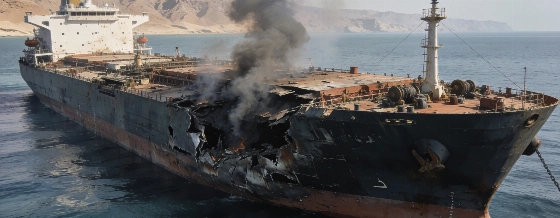
Shipping traffic through the Strait of Hormuz has dropped after two ships were struck by unidentified projectiles off the coast of Oman, setting one vessel on fire and rattling the region's main shipping route. UK Maritime Trade Operations (UKMTO) confirmed the incident, which has forced shipping companies and authorities to review security measures for one of the world's busiest waterways. Omani officials evacuated 16 crew members from the Saudi-owned tanker Sidr after the attack, and two seamen were reported dead, according to Reuters.
On Thursday, four projectiles hit two ships about four nautical miles west of Khasab, Oman. One ship caught fire; the condition of the second is unclear. A nearby captain said he saw the attack from six miles north of the site. After the incident, ship movements through the strait fell to seven on Thursday, down from eleven the day before and a ten-day average of fifteen, according to Kpler tracking data. Only two ships left the strait-one carrying fertiliser, the other empty-while five entered, loaded with steel, grain, and heavy oil products. Over the past ten days, average daily traffic through the Strait of Hormuz dropped to ten commodity ships, the lowest since May, as confirmed by UKMTO and Reuters. Since July 6, at least 27 projectile strikes have hit vessels in and around the strait, raising the risk for commercial shipping.
Regional response and security talks
In response, Iran has called an emergency regional summit in Oman on Monday, inviting Gulf states and Iraq. The meeting aims to restore trust and set up safer shipping routes through the Strait of Hormuz. Ismail Baghaei, spokesperson for Iran's foreign ministry, called the meeting an effort to support peace and stability without outside interference. The National News reported that Iranian and Omani officials have agreed in principle on a new shipping corridor, with maps expected to be signed soon, though the plan has not yet been tested as attacks continue.
Iran's Islamic Revolutionary Guard Corps (IRGC) has said that Khasab, Oman, marks the "end of the safe route" for ships Tehran sees as violating maritime rules, effectively drawing a line for enforcement. The U.S. Maritime Administration has repeated warnings that Iran continues to threaten and strike commercial vessels in the Persian Gulf, Strait of Hormuz, and Gulf of Oman, highlighting the broader security risk. The Emirates News Agency (WAM) has noted the UAE's ongoing work with regional partners to keep maritime trade safe, in line with the Dubai Economic Agenda D33 and UAE Vision 2031, which focus on secure trade corridors and resilient logistics.
International involvement and uncertainty
South Korea has responded by sending a team to assess the situation, after its foreign minister spoke with his Iranian counterpart at Tehran's request. Seoul is considering whether to send military assets to the region, but has not made a decision. The Korean foreign ministry said the call focused on the "current situation in the Middle East" and the security of the Strait of Hormuz. The Dubai Media Office has stressed the importance of uninterrupted shipping for the emirate's logistics and energy sectors, which are central to the UAE's non-oil GDP and investment plans.
For shipping, logistics, and energy companies based in Dubai, the sudden drop in vessel movements and the risk of more attacks mean higher insurance costs, rerouted cargo, and possible delays. The Strait of Hormuz is the main route for Gulf oil exports, and any lasting disruption would quickly affect regional economies and global energy markets. The Central Bank of the UAE (CBUAE) has previously said that instability in shipping lanes can impact trade balances and liquidity, leading to close monitoring by financial regulators and the Dubai Financial Services Authority (DFSA).
While Iran presents itself as a guarantor of regional security, the timing of these attacks and the upcoming summit raise questions about who really controls Gulf waters. The sharp drop in shipping traffic shows that confidence in current security arrangements has weakened. Unless regional states can provide real guarantees for safe passage, Dubai's shipping and trade sectors will remain exposed to risk, with costs likely passed on to businesses and consumers across the Gulf. For updates on maritime security and trade policy, see the Emirates News Agency.