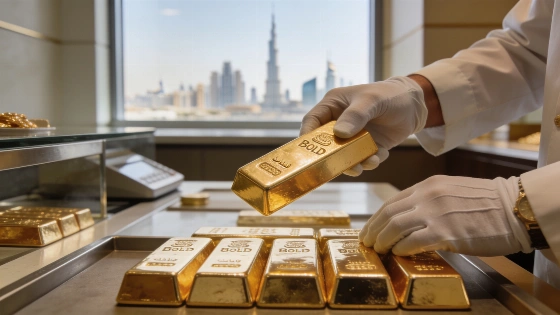
Gold from African war zones keeps moving through Dubai's business core. It passes through companies blacklisted by the United States for illegal trade. Bloomberg's latest investigation lays out a tangled network that still pushes billions in untraceable gold through the city. Sanctions and global pressure have not stopped it. The Emirates News Agency (WAM) has promoted Dubai's ambitions as a world hub for precious metals. But these new findings show how tough it is to regulate the sector.
Belgian gold dealer Alain Goetz sits at the heart of this network. US authorities have tracked his operations for years. In March 2022, the US Treasury hit Goetz's network with sanctions. They accused him of helping fund armed conflict by buying gold from the Democratic Republic of Congo without checking where it came from. One refinery tied to Goetz bought gold from mines run by armed groups in South Kivu, eastern Congo. The African Gold Refinery (AGR) in Uganda, once linked to Goetz, shut down in April 2024 after a board vote. Goetz insists AGR was a legal, regulated business. He says any failures in checking gold origins were not on purpose, according to Bloomberg.
Sanctioned companies and Dubai's gold trade
Sanctions have not stopped the gold. Trade data from Bloomberg shows that in 2024, Rwanda sent at least 11 tonnes of gold to PGR Gold Trading LLC. This Dubai company is flagged by the US as part of Goetz's network. The investigation also found that African Gold Refinery in Uganda, another company sanctioned by Washington, shipped about $377 million in gold to a Goetz-linked Dubai firm in 2017. These deals happened as worries grew about gold from Congo's conflict zones entering world markets. In June 2026, the US and European Union put more sanctions on Rwanda's only gold refinery. They accused it of handling gold mined by rebels in Congo. Reuters and Bloomberg covered the move widely.
The Sentry, a US financial investigations group, reviewed documents that show the scale. In a 2017 diplomatic cable, Goetz told a US embassy official in Kampala that about 156 tonnes of gold had been smuggled to the Middle East in business-class luggage. Goetz admitted he could not trace the gold his refinery exported. The Central Bank of the UAE (CBUAE) has since issued new rules to tighten anti-money laundering (AML) controls in the gold sector. The government says it wants to match global compliance standards. These steps fit into the UAE Vision 2031 and the Dubai Economic Agenda D33, both of which call for more transparency and steady growth in key sectors.
Regulatory gaps and the scale of illicit flows
The Goetz network came back into focus in 2026. That year, the US and EU sanctioned a Rwandan refinery linked to him. They said it processed gold smuggled from rebel-held mines in Congo. Still, companies tied to the network keep showing up in African gold trade routes, Bloomberg reports. SWISSAID says that from 2012 to 2022, the UAE imported about 2,569 tonnes of undeclared African gold worth around $115 billion. The numbers show a big gap between what African countries report as exports and what the UAE records as imports. In 2024, the UAE brought in an estimated 29 tonnes of gold from Sudan, 31 tonnes from Uganda, and 19 tonnes from Rwanda. These countries often act as waypoints for gold smuggled out of the DRC, as detailed in a Bloomberg special report.
SWISSAID, which tracks illegal gold flows, estimates that $24 billion to $35 billion in African gold is smuggled into world markets each year. Much of it passes through the UAE. The number of registered precious metals and gemstone traders in the UAE jumped from about 4,500 in 2022 to nearly 8,000 by 2025, according to Bloomberg. Ivan Schultz, a SWISSAID researcher, calls the UAE's loose controls on gold trading companies a "major loophole" for tracking gold's path. The Dubai Multi Commodities Centre (DMCC) and the Dubai Financial Services Authority (DFSA) have both rolled out new compliance rules to plug these gaps, as reported by The National and the Dubai Media Office.
These findings echo warnings in a previous investigation about Dubai's key place in global trade routes. Old shipping lanes face trouble. Dubai's role is under the microscope.
Dubai's position under international spotlight
The investigation puts Dubai's gold sector back in the global spotlight. UAE-registered companies keep turning up in networks already hit by US sanctions. Dubai is now a major gold trading hub. But gold from African conflict zones keeps coming in, often through sanctioned firms. The city's rules have holes. That puts pressure on officials to keep watch. The UAE Ministry of Economy says it is sticking to global best practices. The Virtual Assets Regulatory Authority (VARA) has widened its reach to cover digital gold trading platforms. The market is changing fast.
Dubai's gold trade has grown faster than its oversight. As long as these gaps stay open, the city risks becoming the top gateway for illegal gold. That hurts its reputation and global supply chains. The facts are plain. If loopholes stay open, Dubai's gold market will keep drawing shadowy flows that fuel conflict and dodge global controls. Real reform and tougher checks from UAE officials and global partners are needed to restore trust and keep Dubai's gold sector strong for the long haul.