
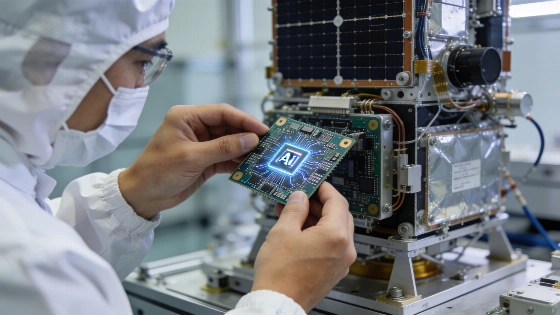
Google is pushing its AI hardware into space. The company plans to launch an experimental satellite to see if its AI chips can survive the tough conditions outside Earth. This move marks a new step in the race to bring advanced computing to places where regular data centers can't go. Tech and investment circles around the world, including in the UAE, are watching closely.
The mission comes down to a clear question: can Google's custom Tensor Processing Units (TPUs) keep working in low Earth orbit? Space brings radiation, wild temperature swings, and physical stress that often break normal hardware. Reuters reports that the launch will ride on SpaceX's Transporter-18 mission. Google is teaming up with Planet Labs for this test.
AI hardware faces the real test in orbit
Google's blog points out that satellites in low Earth orbit get sunlight almost all the time. This means they can make up to eight times more solar power than on the ground. That much energy could let satellites run much bigger AI workloads. But Google says only a real test in orbit can prove if the hardware will hold up. Some problems just can't be recreated on Earth.
This is a trial run, not a full rollout. Google says the main goal is to see how its chips handle radiation, temperature swings, and the rough ride of launch and space. The company is not building a full data center in orbit yet. This focus on research lines up with the UAE's own push for tech innovation, as set out in the Dubai Economic Agenda D33 and the UAE Vision 2031. Both plans put advanced technology and space at the center of future growth.
Reuters adds that Google has already tested its TPUs with AI workloads in labs at the University of California, Davis. But only a real space test can show how the chips perform in orbit. The mission uses rideshare logistics with SpaceX and works with Planet Labs. This kind of public-private partnership is becoming more common in the space industry. The UAE Space Agency is backing similar efforts, as seen in recent Emirates News Agency (WAM) releases about national space projects.
Engineering hurdles and what comes next
Google points to two big technical problems beyond the chips themselves. First, cooling data centers in orbit is tough. Second, satellites need to talk to each other at very high speeds over short distances. Both are key if AI-powered satellites are ever going to work together as a network and handle complex jobs in real time. These issues match the infrastructure goals set by the Dubai Future Foundation and the Abu Dhabi Global Market (ADGM), which both call for strong digital and physical systems to support new tech.
Google is putting its own hardware on the line in space, not just running simulations or ground tests. If the chips make it and work as planned, it could open the door for AI-powered satellite networks and data processing in orbit. For now, this is a test of both technology and nerve. The outcome could push the limits of AI far beyond Earth and spark more investment and new rules in the UAE's fast-changing tech scene.