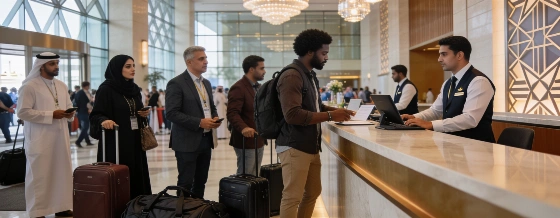
Dubai has moved away from treating events as isolated highlights. Instead, the city is building an economic model that connects hospitality, aviation, and investment, aiming to make every major event a springboard for ongoing economic activity. This approach fits with the Dubai Economic Agenda D33 and the UAE Vision, both of which focus on diversifying the economy and supporting long-term growth in key sectors.
Central to this shift is Dubai's infrastructure and its ability to attract international visitors for more than just a single event. The Dubai Department of Economy and Tourism (DET) reports that the city welcomed 19.6 million international guests in 2025, with nearly 2 million arriving in December alone. These numbers reflect Dubai's global draw and a packed event calendar, as reported by The National. The city's strategy is straightforward: link sporting and cultural events with hotels, airlines, and entertainment so that visitors engage with the city beyond the event itself.
Unified strategy replaces fragmented events
At the recent Arab Forum for Sports Tourism in Dubai, industry leaders said the era of one-off events is over. They called for a unified calendar and partnerships that connect tourism authorities, airlines, hotels, investors, and media. The goal is to make cities in the region year-round destinations for international gatherings, training camps, and a range of experiences. The Dubai Media Office has pointed out that this kind of integration supports the emirate's ambition to be a global center for business and leisure. Regulatory frameworks from organizations like the Dubai International Financial Centre (DIFC) and Dubai Multi Commodities Centre (DMCC) help attract foreign investment.
Speakers such as Fazila Al Muaini, head of the UAE Journalists Association, and Khaled Al Nabulsi, deputy head of the Arab Talent Support Organisation, argued that Dubai's model could work across the region. Al Nabulsi suggested creating a single regional events calendar and appointing top talent as ambassadors, turning each event into a platform for promoting local identity and culture.
Media and technology drive global reach
Media now plays a bigger role than just reporting results. As Al Muaini noted, it helps shape the city's image and highlight its culture to a global audience. Digital platforms, data, and artificial intelligence are also speeding up how Dubai manages events, connects with visitors, and markets itself. At the Arabian Travel Market 2026, DET's head of AI, Dr. Marwan Al Zarouni, said artificial intelligence is now central to Dubai's tourism strategy, supporting digitalization, personalization, and smarter management of visitor flows, as covered by Gulf News.
Khaleefa Al Shamkhi, director at Al Dar Media in Oman, added that the real value of an event is in the visitor's full experience-from booking flights and hotels to exploring the city's heritage and entertainment. This broader approach is what separates Dubai from cities that treat events as isolated moments.
Economic impact extends beyond the stadium
Dubai's model is about more than filling seats. Each visitor supports airlines, hotels, restaurants, shopping, and cultural sites. In the first eight months of 2026, Dubai hosted 6.97 million international overnight guests, with August being the strongest month since February, according to DET data cited by Emirates247. Hotel occupancy reached 66% in August 2026, or 89% of the previous year's level, showing steady demand. Hotels recorded 21.61 million occupied room nights over the same period, pointing to ongoing growth and longer visitor stays.
As reported earlier, Dubai's expansion of public spaces and attractions is already bringing in record visitor numbers, supporting the city's strategy of tying events to wider tourism development. The Emirates News Agency (WAM) has also covered the government's focus on infrastructure investment and regulatory changes, which help keep Dubai competitive in the global tourism market.
For investors and operators, the message is clear: cities that can turn every event into ongoing economic activity will lead. Dubai's investment in infrastructure, digital tools, and partnerships is setting a new standard for the region. The city's leadership is focused on building a system where every visitor, event, and partnership adds to long-term economic growth. Other cities in the region now face a choice: adapt to this integrated model or risk falling behind as Dubai redefines what it means to be a global destination.