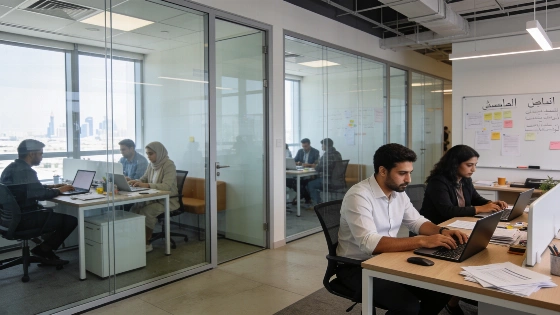
Dubai's flexible office market just broke a record. Occupancy rates have climbed as high as 85 percent. Total supply now tops 1.2 million square feet. No other city in the Middle East or Africa comes close. This isn't just a number. It marks a real change in how companies in the UAE use office space. Many are rethinking their real estate plans as technology and the economy shift. Emirates News Agency (WAM) links these trends to the UAE's push for economic diversification under the Dubai Economic Agenda D33 and UAE Vision 2031.
JLL's latest report puts the UAE at the top of the region for flexible offices. Dubai's rapid growth and strong demand are driving this lead. The report, "Flexible Workspace Market in the Middle East and Africa 2026," points out that over 90 percent of big property portfolios in the region are still locked into long leases. But that's changing. More businesses want flexible options as they face new challenges from artificial intelligence and changing work habits. The Dubai Media Office says the government is backing innovation in commercial property. It's pushing for new rules and better infrastructure to draw global investors.
Dubai's lead and a changing office scene
Dubai's flexible workspace market isn't just getting bigger. It's getting more varied. The city now offers more than 1.2 million square feet of flexible space. Occupancy rates run between 75 and 85 percent. Since 2022, about 55 percent of this space has come online. Operators are betting big. Dubai stands out for its range of choices. Tenants can pick from high-end business districts or more affordable hubs like Jumeirah Lakes Towers. This means more options and better prices. JLL data, as cited by Zawya research, confirms Dubai is the region's largest and most developed flexible workspace hub.
Private offices rule the market. About 95 percent of flexible space in Dubai's central business district is set aside for closed offices. This setup fits the needs of finance and professional services firms that need privacy and to meet regulations. The market is stable. Tenants are a mix: 55 percent are regional or local, and 40 to 45 percent are international. There's a steady flow of new companies, expansions, and moves. The Central Bank of the UAE (CBUAE) says this mix helps Dubai stay strong even when the global economy stumbles.
Operators have had to adapt to recent geopolitical tensions. Instead of slashing rents, they've offered incentives and flexible lease terms to keep prices steady. This has kept Dubai's flexible office market stable, unlike some other cities. Office supply is getting tighter. Vacancy rates dropped to 6.1 percent in Q2 2026. Rents for Grade B offices jumped 31.5 percent year-on-year. Grade A rents rose 26.2 percent, according to Lyukos. That's a sharp climb.
Abu Dhabi's new approach
Dubai may be bigger, but Abu Dhabi is changing fast. The capital now has 366,000 square feet of flexible workspace. Occupancy runs between 70 and 85 percent. Abu Dhabi is moving from a small, niche market to a broader ecosystem. Big new spaces opened in 2024 and 2025. Emarat Al Youm business coverage credits this growth to active government policies and a focus on attracting global business.
The Abu Dhabi Global Market (ADGM) is key. It hosts 57 percent of operators. ADGM aims to build a unique financial center with its own rules. This draws new companies. Most tenants are newcomers. Abu Dhabi also leads the region in demand for new commercial space. Sixty to seventy percent of enquiries come from companies looking for new offices. Of that, 45 to 55 percent are from international firms. The capital is getting more connected to the global economy. The Abu Dhabi Media Office points to ADGM and other free zones as drivers of competitiveness and new regulations.
Flexible workspaces and what's next for real estate
The report shows a big gap worldwide. Only 5 percent of companies globally put more than 10 percent of their real estate into flexible space. Over 40 percent use just 1 percent or less. Dana Williamson, Head of Offices, Business Space, and Retail for Middle East and Africa at JLL, calls this a "critical juncture." Supply is steady. Demand is rising. AI is changing what companies need. Williamson says flexible workspaces now help companies manage risk as work habits keep shifting.
For investors and operators, this is a rare chance. Fast action could mean big returns. The UAE is moving faster than other regional markets, where long leases still rule and change is slow. Dubai CommerCity reports nearly 96 percent occupancy across its office, logistics, and retail spaces. It just announced a USD 490 million expansion. New office formats will include shell-and-core, fully fitted, and plug-and-play spaces, as covered by Arabian Business.
The commercial property market is changing. Dubai's flexible workspace boom is setting a new standard for the region. The city's mix of size, variety, and resilience stands out. Abu Dhabi's careful expansion shows this isn't just about one city. The UAE's flexible office story is growing. For anyone watching the region's economy, these changes matter as much as the recent moves in UAE stock markets. The facts are clear. Flexible workspaces are now a core part of the UAE's commercial real estate. Those who move fastest will shape the next chapter for business in the region.